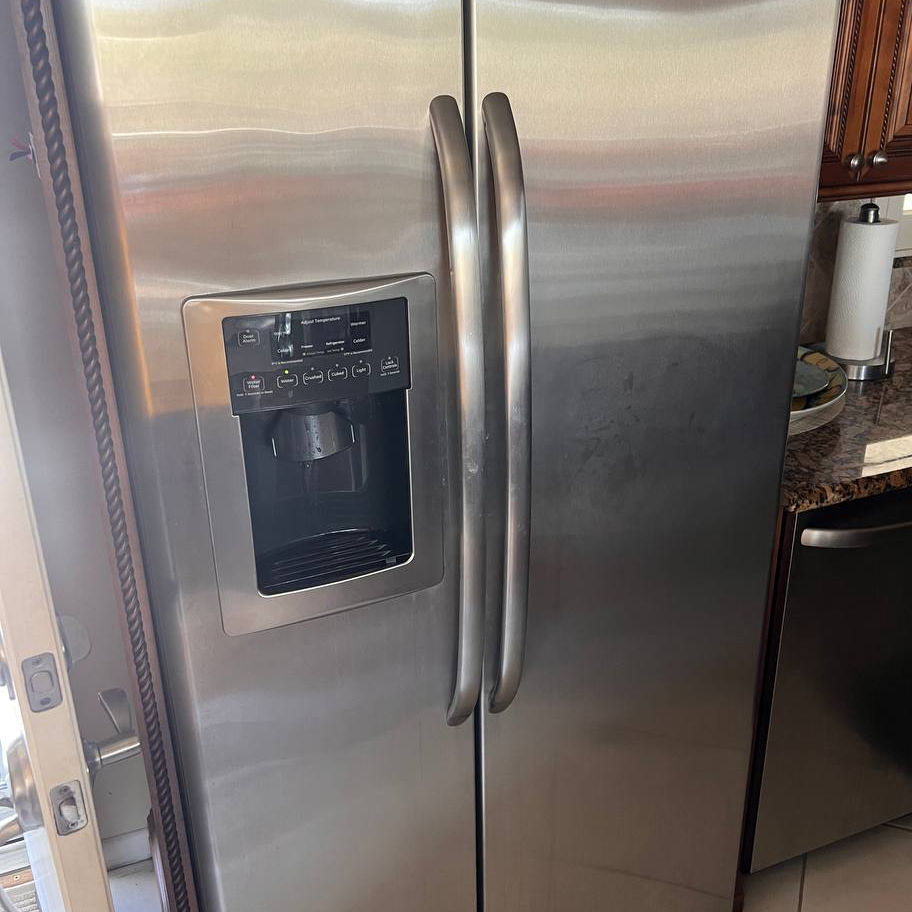
You press a glass against the refrigerator dispenser and get water—but nowhere near as much as you used to.
What once filled a glass in a few seconds now takes much longer. The stream may start strong and quickly weaken, or it may come out as a steady trickle from the beginning.
Sometimes the ice maker starts producing smaller or hollow cubes at the same time.
That combination can make it look like several refrigerator parts are failing at once.
Usually, the better place to start is with one question:
Is enough water actually reaching the refrigerator?
A slow refrigerator water dispenser can be caused by something as simple as an old filter or a kinked supply line. It can also point to a restricted filter housing, frozen water tube, low household pressure, or a water inlet valve that is no longer opening completely.
Testing the water path in the right order can prevent unnecessary parts replacement.
A Recent Refrigerator Repair in Fort Myers
On a recent refrigerator repair call in Fort Myers, the homeowner showed us a dispenser that still worked, but filling a glass had become frustratingly slow.
The problem had developed gradually.
At first, the difference was barely noticeable. Then the ice maker started producing smaller cubes, and the dispenser flow dropped even further.
The refrigerator itself was cooling normally.
There were no leaks and no error codes.
That was an important clue. Because both the dispenser and ice maker depend on the refrigerator’s water supply, two water-related symptoms appearing together suggested that we should inspect the supply side before treating them as separate failures.
We started with the household water connection and supply line.
The line was open and not visibly kinked.
Next, we checked the refrigerator filter. It was well past its normal replacement interval, so restriction there was possible.
After installing a new filter, water flow improved slightly—but it was still below normal.
That told us the filter was part of the problem, but not the entire problem.
We then tested the water inlet valve.
The valve was receiving the correct electrical signal but was not opening fully under demand. Internally, it had become restricted.
The valve was replaced, the new filter was installed correctly, and the water system was flushed.
After the repair, the dispenser returned to a steady stream and the ice maker received normal water volume again.
The important part of the repair was not simply replacing the valve.
It was separating the different restrictions and confirming which one was actually limiting water flow.
Start With the Refrigerator Water Filter
If your refrigerator has a water filter, this is one of the easiest places to start.
As water moves through the filter, sediment and other material collect inside the filter media.
Over time, that restriction increases.
Eventually, water may still pass through—but much more slowly.
A restricted filter can affect both:
- water dispenser flow;
- ice maker fill volume.
This is why a refrigerator may still make ice while the cubes gradually become smaller.
Check when the filter was last changed.
Replacement intervals vary by manufacturer, water quality, and usage, so follow the recommendation for your particular model.
If you replace the filter, make sure it is fully seated.
An incorrectly installed filter can create its own flow problems.
What If the Water Flow Became Slow Right After Changing the Filter?
That is a different clue.
If the dispenser worked normally before the filter replacement and immediately became weak afterward, check the filter installation.
Possible issues include:
- the filter is not completely locked into position;
- the wrong filter was installed;
- protective caps or packaging were not fully removed;
- air is still trapped in the water system;
- the replacement filter itself is restricted;
- the filter housing is not opening correctly.
Do not immediately assume the refrigerator developed an unrelated failure at exactly the same time.
Start with what changed.
Flush the System After Replacing the Filter
A new refrigerator filter may introduce air into the water lines.
The dispenser can sputter or produce an uneven stream until that air is removed.
Follow the manufacturer’s flushing instructions for the refrigerator.
Usually, this means dispensing water in intervals until the flow becomes steady.
If the flow remains consistently weak after the air has been removed, another restriction may be present.
Check the Supply Line Behind the Refrigerator
The refrigerator normally receives water through a narrow supply line connected to the household plumbing.
If the refrigerator has recently been moved—for cleaning, remodeling, flooring work, or service—the line can become kinked behind the cabinet.
A partially crushed line may not stop the water completely.
Instead, it limits how much water can move through the system at one time.
The result can be:
- slow dispenser flow;
- small ice cubes;
- longer ice production times.
If the refrigerator can be safely moved, inspect the visible supply line for sharp bends or compression.
Do not pull on the line or fittings.
If you see damage, deterioration, or leakage, shut off the water supply before the problem becomes larger.
Make Sure the Household Shutoff Valve Is Fully Open
Another simple possibility is the water shutoff valve supplying the refrigerator.
A partially closed valve can reduce flow enough to affect both the dispenser and ice maker.
This sometimes happens after plumbing work or after the refrigerator has been disconnected.
Confirm that the appropriate supply valve is fully open.
If the valve is corroded, leaking, or difficult to operate, do not force it.
The issue may require plumbing service rather than appliance repair.
Could Low Household Water Pressure Cause a Slow Dispenser?
Yes.
A refrigerator cannot create water pressure—it relies on the pressure supplied by the home.
If water pressure is too low, the refrigerator dispenser and ice maker may both operate poorly.
Pay attention to other fixtures.
If faucets or other water-fed appliances have also become noticeably weaker, the issue may be broader than the refrigerator.
If household pressure seems normal everywhere else, the restriction is more likely to be within the refrigerator supply path.
The Water Inlet Valve Can Become Restricted
The water inlet valve controls water entering the refrigerator.
When you press the dispenser paddle, the refrigerator sends an electrical signal that opens the appropriate section of the valve.
Water then moves toward the dispenser.
Another section may supply the ice maker, depending on the refrigerator design.
A valve does not always fail completely.
Sometimes it still opens, but not far enough to provide normal flow.
That can make diagnosis confusing because the dispenser technically still “works.”
Signs of a weak or restricted inlet valve can include:
- dispenser flow gradually becoming slower;
- ice cubes becoming smaller;
- delayed ice production;
- normal household water pressure;
- no obvious kink in the supply line;
- little improvement after replacing the filter.
The valve should be tested before replacement.
A slow dispenser alone does not prove that the valve has failed.
Why the Ice Maker Can Be an Important Clue
The dispenser and ice maker often share part of the same incoming water system.
That means the ice maker can provide useful diagnostic information.
For example:
Dispenser is slow and ice cubes are smaller:
A restriction affecting the shared water supply becomes more likely.
Dispenser is slow but ice production is completely normal:
The restriction may be farther downstream in the dispenser-specific water path.
Ice maker is weak but dispenser flow is normal:
The problem may be isolated to the ice-maker fill circuit.
Looking at both systems helps narrow down where water flow is being lost.
Could the Water Line Inside the Refrigerator Freeze?
Yes.
Some refrigerators route dispenser water through tubing located inside or near cold areas of the appliance.
If that tubing freezes, water flow can become restricted or stop completely.
A frozen line can sometimes be associated with:
- unusually cold refrigerator settings;
- temperature-control problems;
- airflow issues;
- door or insulation problems.
Do not apply uncontrolled heat to refrigerator tubing.
Using a heat gun, boiling water, or other aggressive methods can damage plastic components and insulation.
If a frozen line keeps returning, the reason it is freezing should be diagnosed rather than repeatedly thawed.
The Filter Housing Can Also Restrict Flow
The refrigerator filter itself is not the only part of the filtration system.
Water also has to pass through the filter head or housing.
Depending on the model, internal valves in the housing open when the filter is installed.
If those components wear, stick, or become restricted, installing a new filter may not restore normal flow.
This is one reason technicians should compare water flow at different points in the system rather than assuming every low-flow complaint is solved by a filter.
What If the Dispenser Makes Noise but Little Water Comes Out?
Listen to the refrigerator while pressing the dispenser.
If you hear the valve energize but get only a small amount of water, the system may be trying to operate normally against a restriction.
Possible causes include:
- clogged filter;
- restricted inlet valve;
- kinked supply line;
- low supply pressure;
- frozen tubing.
If you hear no normal valve response at all, the diagnostic path may shift toward the dispenser switch, wiring, control system, or valve electrical circuit.
The exact symptom matters.
What If Water Flow Changes From One Day to the Next?
Intermittent flow can point to a different type of problem.
For example, a partially frozen line may allow more water after warming and less after the refrigerator has been closed for several hours.
A failing inlet valve may also behave inconsistently.
Record when the problem occurs.
Does the dispenser work better:
- after the refrigerator door has been open?
- immediately after replacing the filter?
- at certain times of day?
- after the refrigerator has been moved?
Those observations can help identify a pattern.
Do Not Replace the Control Board First
A slow water dispenser usually has several simpler causes that should be eliminated before the refrigerator’s electronic control becomes the main suspect.
The control board can affect valve operation, but a mechanical restriction produces very similar symptoms.
Before recommending an electronic control, the diagnostic process should consider:
- household water supply;
- shutoff valve;
- supply line;
- refrigerator filter;
- filter housing;
- water inlet valve;
- internal water tubing;
- dispenser electrical controls when necessary.
Replacing expensive electronics without checking water flow first is not a reliable approach.
When Should You Schedule Refrigerator Repair?
Professional refrigerator repair makes sense when:
- dispenser flow remains weak after replacing the filter;
- both dispenser flow and ice production are getting worse;
- water pressure elsewhere in the home is normal;
- the refrigerator supply line is open and not kinked;
- water flow changes unpredictably;
- the dispenser stops completely;
- the inlet valve makes unusual sounds;
- the internal line repeatedly freezes;
- water leaks appear around the refrigerator or valve.
If you see a leak, shut off the refrigerator water supply until the source can be identified.
A low-flow problem is inconvenient.
A failed water connection can damage flooring and cabinets.
Refrigerator Water Dispenser Repair in Fort Myers
Appliance Repair Fort Myers provides refrigerator repair and appliance repair throughout Fort Myers, Cape Coral, Estero, Bonita Springs, Naples, and nearby communities.
When a refrigerator water dispenser becomes slow, the goal is to identify where the water flow is being restricted—not replace every component connected to the system.
Depending on the symptoms, diagnosis may include the household supply, filter, filter housing, water line, inlet valve, internal tubing, dispenser controls, and ice-maker water circuit.
After the repair, water flow should be tested again and the refrigerator should be checked for leaks.
If your refrigerator dispenser has gradually gone from a strong stream to a trickle, start with the filter and visible water-supply checks.
If normal flow does not return, professional refrigerator repair in Fort Myers can determine whether the restriction is in the supply, valve, filtration system, or internal water path.