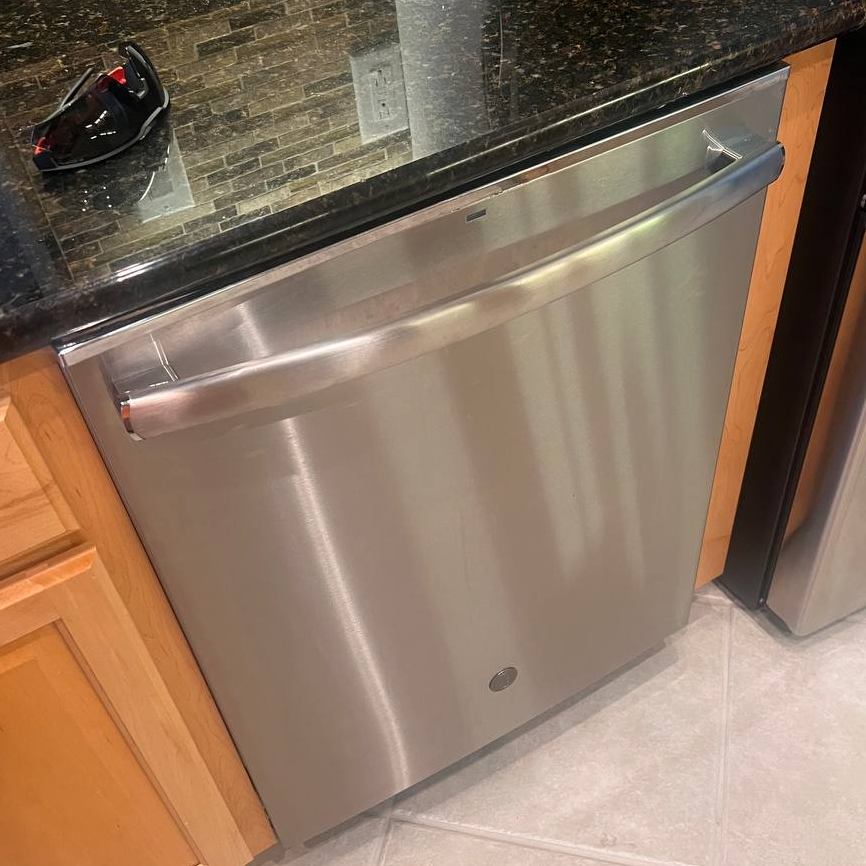
You start the dishwasher after dinner, come back much later, and it is still running.
The cycle used to finish on time. Now it seems to sit on the same stage forever, pause repeatedly, or add another hour when you thought it should be almost done.
A long dishwasher cycle does not automatically mean the control board has failed.
Modern dishwashers adjust cycle time based on water temperature, soil level, heating performance, and sensor feedback. If one of those systems is not behaving normally, the dishwasher may keep extending the cycle because it believes the required conditions have not been reached.
The useful question is not simply, “Why is my dishwasher running so long?”
It is: what is the dishwasher waiting for?
A Recent Dishwasher Repair in Fort Myers
On a recent dishwasher repair call in Fort Myers, the homeowner had noticed a gradual change.
The dishwasher still filled with water. The spray arms were moving, and the machine was not displaying an error code.
But a cycle that normally finished within a predictable window had started taking much longer.
The machine would wash, pause, run again, and appear to stay in the heating portion of the cycle for an unusually long time.
Since the dishwasher was still operating, the homeowner suspected the electronic control.
We started with the conditions the control was monitoring instead.
Incoming water temperature was acceptable. The heating element was drawing power and producing heat.
But when we compared actual water temperature with the temperature value being reported to the control, the readings did not match.
The temperature sensor was no longer reporting accurately.
The dishwasher had already heated the water, but the control did not know it. It kept extending the cycle while waiting for a target temperature that had effectively already been reached.
After replacing the faulty sensor, we ran a complete test cycle.
The dishwasher heated properly, advanced through the stages normally, and completed the cycle without the excessive delay.
The control board did not need to be replaced.
That is why diagnosis matters before parts are ordered.
Why Does Water Temperature Affect Cycle Time?
Dishwashers rely on hot water for cleaning, detergent performance, sanitation, and drying.
Depending on the cycle, the dishwasher may pause while the heating system raises the water temperature.
If the incoming water is much colder than expected, the machine may need more time.
This is why a dishwasher can appear to be “stuck” even though it is actually waiting for the proper temperature before continuing.
A small increase in cycle time can be normal.
A major, sudden change from the dishwasher’s usual behavior deserves more attention.
Check the Hot Water Before Assuming the Dishwasher Is Broken
One safe check is to look at the hot-water supply.
Before starting the dishwasher, run the kitchen faucet until the water becomes hot.
Then start the cycle.
If the dishwasher is located far from the water heater, cold water sitting in the plumbing can enter first. The machine then has to spend extra time heating that water.
This does not explain every long-cycle complaint, but it is worth ruling out before diagnosing internal parts.
If the kitchen faucet itself takes unusually long to get hot, the dishwasher may not be the only issue.
A Weak Heating Element Can Extend the Cycle
The heating element does more than help dry dishes.
On many dishwashers, it also raises or maintains water temperature during parts of the wash cycle.
A heating element can fail completely, but it can also develop an electrical problem that prevents normal heating.
Possible symptoms include:
- unusually long cycles;
- poor drying;
- cooler-than-normal dishes at the end;
- detergent not dissolving well;
- temperature-related error codes.
However, a long cycle by itself is not enough reason to replace the element.
The heating circuit should be tested first.
The Temperature Sensor Can Give the Control Bad Information
The dishwasher’s temperature sensor monitors the water and reports that information to the control system.
If the sensor reads too low, the dishwasher may behave as if the water has not reached the target temperature.
That can cause extended heating periods and longer cycles.
If the sensor reads incorrectly in the opposite direction, other heating or cleaning problems may appear.
The important point is that the control board may be doing exactly what it was designed to do—it is simply receiving incorrect information.
That is why replacing the control board first can be an expensive mistake.
What About the Thermostat?
Some dishwasher designs use thermostats or high-limit temperature devices as part of the heating and safety system.
A thermostat problem can interfere with normal heating or cycle progression.
Symptoms can overlap with a bad temperature sensor or heating element, including:
- long cycles;
- incomplete heating;
- poor drying;
- unexpected pauses;
- error conditions.
Testing is needed to determine which part of the heating circuit is actually responsible.
Poor Water Circulation Can Also Make a Cycle Run Longer
Heating is not the only possibility.
The dishwasher also needs to circulate water properly.
If the circulation pump is weak, spray arms are restricted, or filters are heavily blocked, cleaning performance may suffer.
Some dishwashers respond by extending cycle time based on sensor feedback.
Check the parts you can safely access:
- clean the dishwasher filter;
- make sure the spray arms can rotate;
- check that food debris is not blocking spray holes;
- avoid loading tall items where they interfere with the spray arms.
If the dishwasher sounds different than usual or water movement seems weak, the circulation system may need professional testing.
The current Dishwasher Repair page also lists circulation problems among the possible causes of excessively long cycles.
Could the Dishwasher Just Be Using a Longer Cycle?
Yes.
Modern Eco, Auto, Heavy, and Sanitizing cycles can take much longer than older dishwasher cycles.
A long cycle is not necessarily a malfunction if it has always behaved that way.
Compare the machine to its own normal behavior.
Ask:
- Did this same cycle used to finish faster?
- Has the time recently increased?
- Is the dishwasher pausing more than before?
- Are dishes also coming out wet or dirty?
- Has an error code appeared?
A sudden change is more useful diagnostically than the total number of minutes alone.
Check the Cycle You Selected
Before scheduling repair, verify that a different wash option was not selected accidentally.
High-temperature wash, sanitizing, heated drying, or extra-rinse settings can add time.
If the dishwasher has a display, compare the selected options with your usual settings.
You can also consult the owner’s manual for the expected cycle range.
If the settings are normal but the dishwasher now runs significantly longer than it used to, continue investigating.
Can the Control Board Cause Long Cycles?
Yes, but it should not automatically be the first part replaced.
The control board manages heating, circulation, filling, draining, and cycle progression.
A board problem can keep a dishwasher in one stage too long.
But the board also relies on information from:
- temperature sensors;
- thermostats;
- door switches;
- water-level components;
- pumps;
- heating components.
If one of those inputs is wrong, the board may appear to be malfunctioning when it is actually responding to incorrect information.
Good dishwasher repair separates the cause from the reaction.
What If the Dishwasher Pauses for a Long Time?
Pauses can be useful clues.
If the dishwasher pauses while the water is being heated, the issue may relate to:
- low incoming water temperature;
- weak heating;
- incorrect temperature sensing.
If it pauses during washing, circulation or sensor feedback may deserve more attention.
If it stops completely and does not resume, the problem may involve a different system such as the door latch, control, pump, or power connection.
Pay attention to what you hear immediately before the pause.
Is water circulating?
Is the dishwasher quiet?
Does it drain first?
Does the heating element appear to be active?
Those details can help narrow the diagnostic path.
When Does a Long Dishwasher Cycle Need Repair?
Consider professional dishwasher repair when:
- cycle times suddenly become much longer than before;
- the dishwasher repeatedly pauses for extended periods;
- dishes are no longer drying well;
- water does not seem hot enough;
- the dishwasher shows a heating or temperature error;
- dishes remain dirty despite the extended cycle;
- the machine never seems to reach the final stage;
- the same problem happens on several different cycles.
If the dishwasher is operating normally otherwise, one unusually long cycle is not necessarily a failure.
Look for a pattern.
Do Not Guess Based on One Component
A common mistake is to hear “long dishwasher cycle” and immediately replace the heating element or control board.
The same symptom can come from multiple causes.
The site’s current dishwasher service information identifies low water temperature, heating-element problems, thermostat issues, temperature sensors, circulation problems, and control-board faults as possible causes.
A useful diagnostic process should determine:
- whether the dishwasher is receiving sufficiently hot water;
- whether the heating system works;
- whether actual temperature matches sensor readings;
- whether water circulation is normal;
- whether the control is receiving correct information.
Only then should a failed component be identified.
Dishwasher Repair in Fort Myers
Appliance Repair Fort Myers provides dishwasher repair and appliance repair in Fort Myers, Cape Coral, Estero, Bonita Springs, Naples, and nearby communities.
The company’s current service process emphasizes diagnosis before repair and testing afterward.
For a dishwasher with unusually long cycles, that means checking the complete system involved in cycle progression instead of replacing parts based on one symptom.
After the repair, the dishwasher should be run through enough of the cycle to verify that it heats, circulates, advances, and finishes normally.
If your dishwasher used to finish on time but now seems to run all evening, start with the hot-water and loading checks above.
If nothing obvious explains the change, professional dishwasher repair in Fort Myers can determine what the machine is actually waiting for—and whether the solution is a sensor, heating component, circulation problem, or something else.