A walk-in cooler can look like it is working normally and still put inventory at risk.
The evaporator fans are running. The compressor is operating. Product near the back of the box feels cold.
But every time the kitchen staff opens the door, the front of the cooler feels warmer than it should. Moisture begins collecting around the doorway, the refrigeration system runs almost continuously, and frost may start appearing around the evaporator.
That pattern does not always mean the compressor is failing or the system is low on refrigerant.
Sometimes the refrigeration equipment is trying to compensate for a much simpler problem: warm, humid air continuously entering the box through a door that no longer closes or seals correctly.
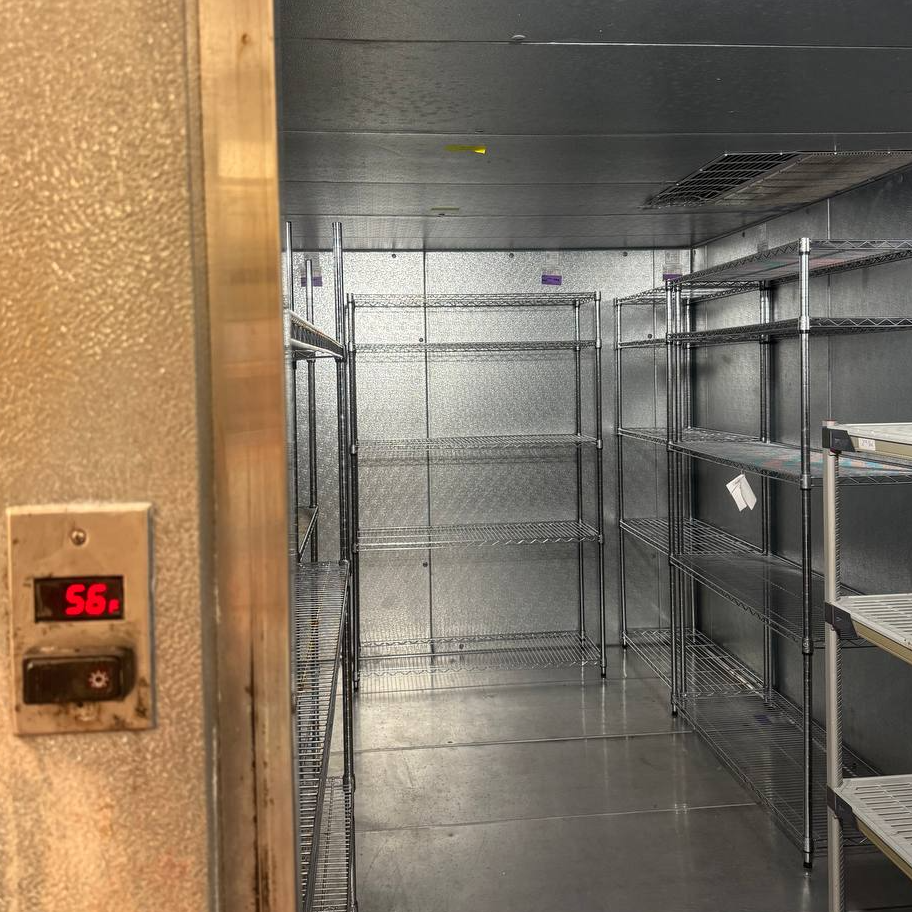
We recently diagnosed exactly that situation during a commercial walk-in cooler repair in Fort Myers.
The Problem: One Side of the Walk-In Was Staying Warmer
The restaurant first noticed the problem during busy service.
Employees were going in and out of the cooler frequently, and staff began noticing that products stored close to the door did not feel as cold as items farther inside.
The cooler was still operating, so there was no obvious total breakdown.
However, several symptoms were beginning to appear together:
- The refrigeration system was running for unusually long periods
- Moisture was forming around the entrance
- The door did not always pull itself completely closed
- Frost was beginning to develop around the evaporator area
- Temperature recovery after busy periods was taking longer
Because the cooler was still producing cold air, the initial concern was a refrigeration-capacity problem.
But the temperature pattern told us to look at the entire box before assuming there was a compressor or refrigerant issue.
Why a Walk-In Door Matters So Much
A commercial walk-in cooler is designed to maintain a controlled environment.
Every time the door opens, some warm air enters. Under normal conditions, that is expected.
The problem begins when the door remains slightly open or the gasket cannot create a complete seal.
In a Fort Myers commercial kitchen, the air outside the cooler may be both warm and humid. If that air continuously leaks into a 35°F–40°F refrigerated space, the system has to remove both heat and moisture.
That increases the refrigeration load.
The system may run longer, the evaporator may collect more frost, and temperatures near the air leak can become inconsistent.
In other words, a refrigeration system can be mechanically functional while the box itself prevents it from maintaining temperature efficiently.
What We Found During the Inspection
We started by checking actual product-zone temperatures instead of relying only on the thermostat display.
Temperatures near the back of the cooler were lower and more stable.
Near the door, temperatures were consistently higher.
Next, we checked the refrigeration system:
- Compressor operation
- Condenser condition
- Evaporator airflow
- Fan operation
- Frost pattern
- Temperature control
- System cycling
Nothing immediately pointed to a major sealed-system failure.
The more important clue appeared when we watched the walk-in door during normal use.
The door would swing toward the closed position, but the closer no longer pulled it firmly into the gasket.
In addition, part of the gasket had become compressed and misaligned.
The result was a narrow but continuous gap.
It was not large enough to look dramatic from across the kitchen, but it was large enough to allow warm kitchen air to enter the cooler for hours every day.
Why the Evaporator Was Beginning to Ice Up
Warm-air infiltration does more than raise box temperature.
It also brings moisture into the cooler.
When humid air reaches the cold evaporator coil, moisture condenses and freezes.
A normal defrost cycle is designed to remove expected frost accumulation.
But if excessive humidity is constantly entering through a leaking door, frost can build faster than the system is designed to handle.
As frost thickens, evaporator airflow decreases.
That creates another problem.
Now the cooler has both:
- Extra heat entering through the door
- Reduced cold-air circulation through the evaporator
The refrigeration system may respond by running even longer.
If the condition continues, the evaporator can eventually become heavily iced and box temperature can rise further.
The Repair
The refrigeration equipment itself did not need a compressor replacement or refrigerant recharge.
The primary repair involved the walk-in door.
We:
- Replaced the worn door-closing mechanism
- Corrected the door alignment
- Adjusted the hinges
- Repositioned the gasket
- Replaced the damaged gasket section
- Checked for light and air gaps around the perimeter
Once the door was able to close firmly on its own, we allowed the refrigeration system to stabilize.
We then checked temperature at multiple locations inside the box instead of testing only near the thermostat.
Temperature became much more consistent between the front and back of the cooler.
The system also began reaching setpoint and cycling normally rather than running nearly continuously.
Why We Did Not Start by Replacing Refrigeration Parts
Commercial refrigeration diagnosis should not start with a parts list.
A walk-in cooler is a complete system that includes:
- Refrigeration equipment
- Evaporator
- Condenser
- Controls
- Fans
- Insulated panels
- Door
- Gaskets
- Hinges and closer
- Air circulation
A problem in any of these areas can affect temperature.
For example, a cooler that runs constantly can be caused by:
- Dirty condenser coils
- Low refrigerant
- Refrigerant leak
- Weak compressor
- Failed evaporator fan
- Frozen evaporator
- Defrost problem
- Thermostat or sensor failure
- Poor door seal
- Damaged door closer
- Excessive door-open time
- Blocked airflow
That is why temperature complaints should be diagnosed as a system rather than by assuming the compressor is responsible.
Signs Your Walk-In Door May Be Part of the Problem
A door problem is worth checking when you notice several of these symptoms together.
The door does not close by itself
Commercial walk-in doors should generally return to a fully closed position after normal use.
If employees routinely have to push the door the last inch, the closer or alignment may need attention.
You can see light around the gasket
With the cooler light off and the surrounding area appropriately lit, visible gaps can indicate that the gasket is not sealing uniformly.
Condensation forms around the doorway
Persistent moisture near the door can be a sign that humid air is entering the refrigerated space.
Frost develops near the evaporator
Not all frost is caused by a defective defrost system.
Excessive moisture entering through a bad door seal can contribute to recurring frost buildup.
The front of the cooler is warmer than the back
Temperature stratification can have several causes, including airflow problems, but an air leak near the door should be considered.
The compressor runs almost constantly
Long run times may mean the system is struggling to remove a continuous heat load.
The cause may be refrigeration-related, but the box and door also need inspection.
A Door Leak Can Become a Refrigeration Problem
An air leak can initially look minor.
The cooler may still hold acceptable temperature overnight when nobody is using it.
Then lunch service begins.
The door opens repeatedly, the closer does not pull it shut completely, and warm kitchen air continues entering.
The refrigeration system runs longer.
More moisture freezes on the evaporator.
Airflow drops.
By the afternoon, temperature recovery becomes slower.
Eventually, what started as a door problem can create symptoms that look much more like a major refrigeration failure.
That is why early correction matters.
What Restaurant Staff Can Check Safely
Some simple observations can help identify a possible door or airflow issue before service arrives.
Watch the door close
Open the door normally and let go.
Does it return fully against the gasket, or stop slightly open?
Inspect the gasket
Look for:
- Tears
- Hard or flattened sections
- Areas pulling away from the door
- Grease or debris preventing contact
Clean the gasket with an appropriate mild cleaner if buildup is interfering with the seal.
Check for blocked door movement
Floor mats, boxes, carts, or damaged threshold components can prevent proper closing.
Compare temperatures
If possible, compare thermometer readings near the front and rear of the walk-in.
A significant difference is useful diagnostic information.
Look at the evaporator
Do not remove panels or chip ice away.
But if you can safely see heavy frost or ice around the evaporator cover, mention it when scheduling service.
What Not to Do
Do not assume the system simply needs more refrigerant.
Refrigerant is not consumed during normal operation. If a system is actually low, there is usually a leak or another issue that should be identified.
Do not repeatedly turn the thermostat colder to compensate for a warm box.
That can cause longer run times without addressing the actual problem.
Do not chip ice from the evaporator with a knife or screwdriver.
Refrigerant tubing and coil surfaces can be damaged easily.
And do not ignore a walk-in door that needs to be pulled or kicked shut every time.
That small gap can place a continuous load on the refrigeration system.
When the Problem Really Is Refrigeration-Related
A proper inspection should still rule out mechanical cooling problems.
Commercial walk-in temperature issues may involve:
Dirty condenser coils
Grease, dust, and kitchen debris can restrict heat rejection and increase compressor operating time.
Evaporator fan problems
A failed or slow fan can prevent cold air from circulating through the box.
Defrost-system failure
Ice covering the evaporator can severely reduce airflow.
Refrigerant problems
Leaks or restrictions can reduce refrigeration capacity.
Control issues
A thermostat, sensor, pressure control, or electronic controller may produce incorrect cycling.
Compressor problems
A compressor that has lost pumping capacity may run but fail to remove enough heat.
The correct repair depends on testing, not on the symptom alone.
Why Temperature Recovery Matters in a Commercial Kitchen
Residential refrigerators typically experience limited door openings.
A restaurant walk-in may be opened dozens or hundreds of times during a shift.
That means the cooler needs to recover efficiently after each opening.
If the box already has a leaking gasket, bad door closer, weak evaporator airflow, or dirty condenser, frequent traffic makes the weakness much more obvious.
During slow periods the cooler may appear normal.
During lunch or dinner rush, temperature begins climbing.
This is one reason commercial refrigeration problems sometimes seem “intermittent” even though the underlying issue is present all day.
Commercial Walk-In Cooler Repair in Fort Myers
Appliance Repair Fort Myers provides commercial appliance and refrigeration service for restaurants and other businesses in Fort Myers, Cape Coral, Estero, Bonita Springs, Naples, and surrounding Southwest Florida communities.
The company lists commercial refrigerators, freezers, walk-in coolers, ovens, stoves, fryers, grills and related equipment among the commercial systems it services, and its commercial refrigeration page specifically includes walk-in cooler repair and preventive maintenance.
For a walk-in temperature problem, diagnosis may include:
- Box temperature
- Door alignment
- Gaskets
- Door closer
- Evaporator airflow
- Fan motors
- Defrost system
- Condenser condition
- Refrigeration pressures
- Temperature controls
- Compressor operation
The objective is not simply to get cold air from the evaporator.
The entire cooler needs to maintain stable temperature under real operating conditions.
When to Schedule Commercial Refrigeration Service
Arrange professional diagnosis if:
- The walk-in runs almost constantly
- Temperature near the door is higher than the back of the box
- The door does not close completely
- The gasket has visible gaps or damage
- Moisture is collecting around the entrance
- Frost repeatedly builds around the evaporator
- Product temperature rises during busy service
- The cooler struggles to recover after frequent door openings
- The refrigeration system is operating but the box still cannot hold temperature
For restaurants and food-service businesses, a cooling issue is easier to manage before product temperature begins rising significantly.
The Refrigeration System Is Only Part of the Walk-In Cooler
A walk-in cooler can have a healthy compressor and still struggle to maintain temperature.
The door, gasket, airflow, insulation, defrost system, and refrigeration equipment all work together.
In this Fort Myers repair case, the key problem was not a failed compressor.
It was warm, humid air repeatedly entering through a door that was no longer closing correctly.
Once the door closer and gasket were repaired and the box was sealed properly again, temperature stabilized and the refrigeration system returned to normal cycling.
If your commercial walk-in cooler is running constantly, frosting up, or staying warmer near the door, schedule a commercial refrigeration diagnostic with Appliance Repair Fort Myers. A complete inspection can determine whether the problem is in the refrigeration system, the airflow, the door—or a combination of all three.