Why Does Your Dryer Keep Running After Clothes Are Dry?
Your clothes feel dry, the dryer is still tumbling, and the automatic cycle seems like it has no intention of ending.
At first, this may look like a minor inconvenience. You can always stop the machine manually, right? But a dryer that consistently keeps running after the load is dry may be telling you that something in the moisture-sensing, airflow, temperature, or control system is no longer working correctly.
The good news is that the problem does not automatically mean the dryer needs a new control board—or a new dryer.
Sometimes the difference between a simple sensor problem and an expensive repair can be found by comparing how the machine behaves on different cycle settings.
Start With One Simple Test
If your dryer normally runs too long on an automatic or Sensor Dry cycle, try a Timed Dry cycle with a normal load.
Pay attention to what happens.
If Timed Dry counts down normally and stops when expected, but Sensor Dry continues running long after the clothes are dry, that is an important diagnostic clue.
Automatic cycles depend on information from the dryer’s moisture-sensing system. If the machine does not receive the correct signal that the clothes have dried, the control may continue the cycle.
That does not necessarily mean the electronic control itself has failed.
The problem can be as simple as dirty sensor bars or a poor electrical connection.
A Recent Dryer Repair in Fort Myers
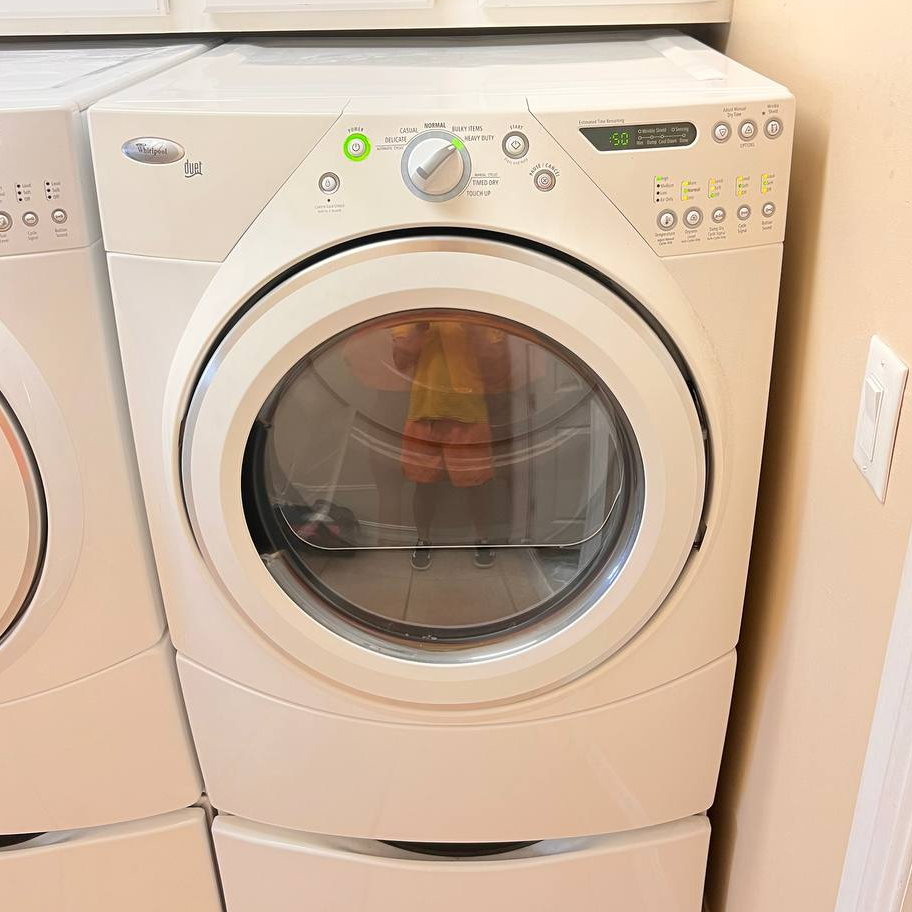
During a recent dryer repair in Fort Myers, the homeowner described a very specific problem: the dryer heated normally, the drum turned, and clothes were getting dry, but Sensor Dry cycles kept running far longer than expected.
There were no error codes.
Timed Dry, however, worked normally.
That distinction helped narrow the diagnosis.
We first checked the exhaust airflow because restricted airflow can change drying performance and affect how an automatic cycle behaves. The vent was clear enough to allow proper airflow.
Next, we inspected the moisture sensor bars inside the drum. They were not heavily coated with residue, so simply cleaning them was not the answer.
Testing the sensor circuit revealed the real problem: a loose wiring connection behind the sensor assembly was causing an inconsistent signal to the control.
The connection was corrected and secured. We then tested both Timed Dry and Sensor Dry with the machine operating under normal conditions.
The automatic cycle began responding correctly and shut off when the load reached the expected dryness level.
The repair did not require replacing the control board.
That is exactly why testing the circuit before ordering parts matters.
How Does a Dryer Know When Clothes Are Dry?
Many modern dryers use metal moisture sensor bars inside the drum.
Wet clothing contacts those bars while tumbling. The control uses changes in the electrical signal to estimate how much moisture remains in the load.
As the clothes dry, the signal changes. The dryer can then reduce the remaining cycle time and eventually stop.
If the sensor cannot accurately detect the load, the machine may behave in different ways.
It may:
- stop too early and leave clothes damp;
- keep running after the clothes are already dry;
- show inconsistent remaining time;
- work normally on Timed Dry but poorly on Sensor Dry;
- produce different results with similar loads.
The sensor bars themselves are only one part of this system. Wiring and electronic controls also have to carry and interpret the signal correctly.
Check the Moisture Sensor First
Dryer-sheet residue and fabric softener can leave a thin coating on moisture sensor bars.
The sensors may look clean even when residue is affecting their ability to read the load.
If your dryer keeps running on automatic cycles, locate the moisture sensor bars according to the owner’s manual and inspect them.
With the dryer off, they can usually be cleaned gently with a soft cloth and a small amount of mild soap. Avoid aggressive abrasives that could damage the surface.
Then test another automatic cycle.
If the behavior changes, residue may have been contributing to the problem.
If nothing changes, further diagnosis may be needed.
Do Not Ignore the Dryer Vent
A dryer that runs too long is not always experiencing a sensor failure.
Restricted airflow is another common possibility.
Hot, moist air has to leave the drum efficiently. When the exhaust path is restricted, drying takes longer and temperatures inside the machine can behave differently than expected.
Check the lint screen first.
Then look at the exterior vent while the dryer is running. The flap should open and you should feel a noticeable stream of exhaust air.
Weak airflow can be caused by:
- lint buildup;
- a crushed or kinked vent hose;
- a long or restricted exhaust run;
- an obstruction inside the vent;
- a damaged blower wheel;
- internal lint buildup.
If the clothes themselves are actually taking a long time to dry—not just the dryer continuing after they are dry—airflow should be high on the diagnostic list.
Could the Timer Be the Problem?
On some dryers, especially models with mechanical timer systems, a failing timer can prevent the machine from advancing through the cycle correctly.
You may notice that the timer knob appears to stay in one position for an unusually long time.
However, replacing the timer based only on that symptom can be a mistake.
Depending on the model and cycle, timer operation can also depend on temperature, moisture sensing, and other electrical conditions.
The correct approach is to determine whether the timer is receiving the signals and power it needs before assuming the timer itself has failed.
What About the Temperature Sensor?
Dryers monitor heat through thermostats, thermistors, or other temperature-sensing components.
If temperature information is incorrect, the control may mismanage the drying cycle.
Possible symptoms can include:
- unusually long cycles;
- overheating;
- insufficient heat;
- cycles ending too soon;
- inconsistent automatic-cycle times.
This is another reason the complete heating and airflow system should be tested rather than replacing the first component that seems related to the symptom.
Could It Be the Control Board?
Yes—but the control board should not automatically be the first conclusion.
A control board can fail and keep a dryer operating when it should stop, but several simpler faults can create similar symptoms.
Before recommending an electronic control, a technician should consider the moisture sensor, sensor wiring, timer operation, airflow, temperature feedback, door switch circuit, and related connections.
Replacing a control board without verifying those systems can turn an accurate diagnosis into expensive guesswork.
Why Timed Dry vs. Sensor Dry Matters
One of the most useful things you can tell a technician is whether the problem happens on every cycle.
For example:
Timed Dry works, Sensor Dry does not:
The moisture-sensing circuit deserves closer attention.
Both Timed Dry and Sensor Dry run indefinitely:
The timer, controls, wiring, or another operating circuit may need testing.
The dryer runs too long because clothes remain wet:
Start thinking about heat and airflow rather than only cycle termination.
The dryer gets extremely hot while running too long:
Stop using it until the airflow and temperature-control system are checked.
Small differences in behavior can significantly change the diagnostic path.
When Should You Schedule Dryer Repair?
Consider professional dryer repair if:
- the dryer regularly keeps running after clothes are dry;
- Sensor Dry no longer ends correctly;
- Timed Dry and automatic cycles behave differently;
- the timer does not appear to advance;
- cycle times have become unpredictable;
- the dryer overheats;
- airflow from the exterior vent is weak;
- you smell something burning;
- cleaning the moisture sensors does not change the problem.
Do not continue running an overheating dryer just to finish the cycle.
Restricted airflow and excessive heat should be inspected before regular use continues.
Dryer Repair in Fort Myers
Appliance Repair Fort Myers provides dryer repair in Fort Myers, Cape Coral, Estero, Bonita Springs, Naples, and nearby communities.
When a dryer keeps running, the goal is not simply to replace the part most commonly associated with the symptom.
A proper diagnosis looks at how the dryer behaves on different cycles and tests the moisture sensors, wiring, airflow, heating system, temperature controls, timer, and electronic controls as needed.
After the repair, the machine should be tested again to verify that the cycle progresses and shuts off correctly.
If your dryer keeps tumbling even after the clothes are dry, try the simple sensor and cycle checks above.
If the problem continues, professional dryer repair in Fort Myers can identify why the machine is not receiving—or responding to—the correct signal to stop.