A refrigerator that seems to run all day can be easy to ignore. The lights work, the food may still feel cold, and there may be no error code or obvious breakdown. But after a while, you may notice something unusual: the compressor or fan noise rarely stops.
Refrigerators are designed to cycle on and off as temperatures change. In Fort Myers and other parts of Southwest Florida, hot and humid weather can make a refrigerator run longer, especially after the doors have been opened frequently or a large amount of warm food has been added.
However, a refrigerator that runs almost continuously for days may be struggling to reach or maintain the correct temperature.
The cause can be as simple as dirty condenser coils or a door that is not sealing properly. It can also involve a condenser fan, evaporator fan, temperature sensor, defrost system, control board, or sealed-system problem.
Here is what to check and when constant operation may require professional refrigerator repair in Fort Myers.
How Much Refrigerator Run Time Is Normal?
There is no single run-time percentage that applies to every refrigerator.
Modern refrigerators may operate for long periods because of their energy-management systems, variable-speed compressors, ambient temperature, door openings, and cooling demand.
Longer operation may be normal after:
- Loading a large grocery order
- Leaving a door open for several minutes
- A power outage
- Adjusting the temperature colder
- Cleaning or defrosting the refrigerator
- Frequent door openings during cooking
- A particularly hot day
The important question is whether the refrigerator eventually reaches the correct temperature and begins cycling normally again.
If it runs continuously while temperatures remain too warm—or the compressor seems to get no meaningful rest for days—the cooling system deserves closer attention.
Common Reasons a Refrigerator Runs Constantly
1. Dirty condenser coils
The condenser releases heat removed from inside the refrigerator.
When the coils become covered with dust, pet hair, or debris, heat transfer becomes less efficient. The cooling system may compensate by operating longer.
Depending on the refrigerator, the condenser may be underneath the cabinet or behind a lower rear panel.
If the coils are accessible without disassembling electrical components, check them for heavy buildup. Follow the manufacturer’s cleaning instructions and disconnect power before performing any maintenance that requires access behind a panel.
2. The refrigerator door is not sealing correctly
Warm, humid air entering through a door gap creates additional work for the cooling system.
Check for:
- Food packages preventing the door from closing
- A loose or damaged gasket
- Hardened or torn gasket sections
- A door that appears uneven
- Dirty gasket surfaces
- Hinges that allow the door to sag
In Fort Myers humidity, even a relatively small air leak can also contribute to condensation or frost.
3. The temperature is set too cold
Lower is not always better.
If the refrigerator or freezer setting has been changed significantly colder than necessary, the compressor may run much longer trying to satisfy the setting.
Instead of relying only on the control-panel number, check the actual compartment temperature with an appliance thermometer.
A refrigerator should generally keep perishable food at 40°F or below, while the freezer is typically set around 0°F.
4. The condenser fan is weak or has stopped
On refrigerators with a fan-cooled condenser, the condenser fan helps move air across the condenser and compressor area.
If the motor slows down, stops intermittently, or cannot maintain proper airflow, heat may build up around the condenser. The refrigerator can continue cooling, but it may have to run much longer to do it.
A failing condenser fan may also produce buzzing, rattling, or irregular fan noise.
5. The evaporator fan is not moving enough cold air
The evaporator fan circulates cold air through the freezer and, on many designs, into the refrigerator compartment.
A weak or failed fan can create an unusual situation: the cooling system keeps running, but cold air is not being distributed correctly.
You may notice:
- Freezer temperature is different from refrigerator temperature
- Some shelves are much warmer than others
- Airflow from the vents feels weak
- The refrigerator runs for unusually long periods
- Fan noise changes or disappears
The fan motor, wiring, ice buildup, or control system may need testing.
6. Frost is blocking the evaporator
A defrost-system failure can gradually cover the evaporator with ice.
Once enough frost accumulates, air can no longer move efficiently through the coil. The compressor may continue operating because the refrigerator cannot bring the compartments to the target temperature.
Possible causes include a defrost heater, sensor, thermostat, wiring, or control problem.
Heavy frost returning after it has been removed is an important clue that the underlying problem has not been corrected.
7. A temperature sensor is giving the wrong information
Modern refrigerators depend on thermistors or other temperature sensors to tell the control system how cold each compartment is.
If a sensor reports an incorrect temperature, the refrigerator may continue calling for cooling even when conditions inside the cabinet are different from what the control system believes.
Because sensor problems can imitate several other failures, electrical testing is important before replacing parts.
8. The sealed system is losing cooling capacity
Constant running combined with poor cooling can sometimes indicate a more serious refrigeration-system problem.
Possible causes include a weak compressor, refrigerant leak, restriction, or another sealed-system fault.
This cannot be confirmed by listening to the compressor or simply assuming the refrigerator “needs Freon.” Temperature readings, airflow, frost pattern, electrical measurements, and sealed-system performance should be evaluated before recommending that type of repair.
A Fort Myers Refrigerator Repair Case: Evaporator Completely Frozen Over
One recent refrigerator repair in Fort Myers involved a unit that was running almost constantly but was not cooling the fresh-food compartment properly.
The homeowner said the freezer still seemed cold, but the refrigerator section was getting warmer. The compressor rarely shut off, and airflow from the refrigerator vents had become very weak.
At first, the problem looked like a weak compressor or a failing evaporator fan. However, the temperature readings and airflow pattern suggested that cold air was not moving through the evaporator area correctly.
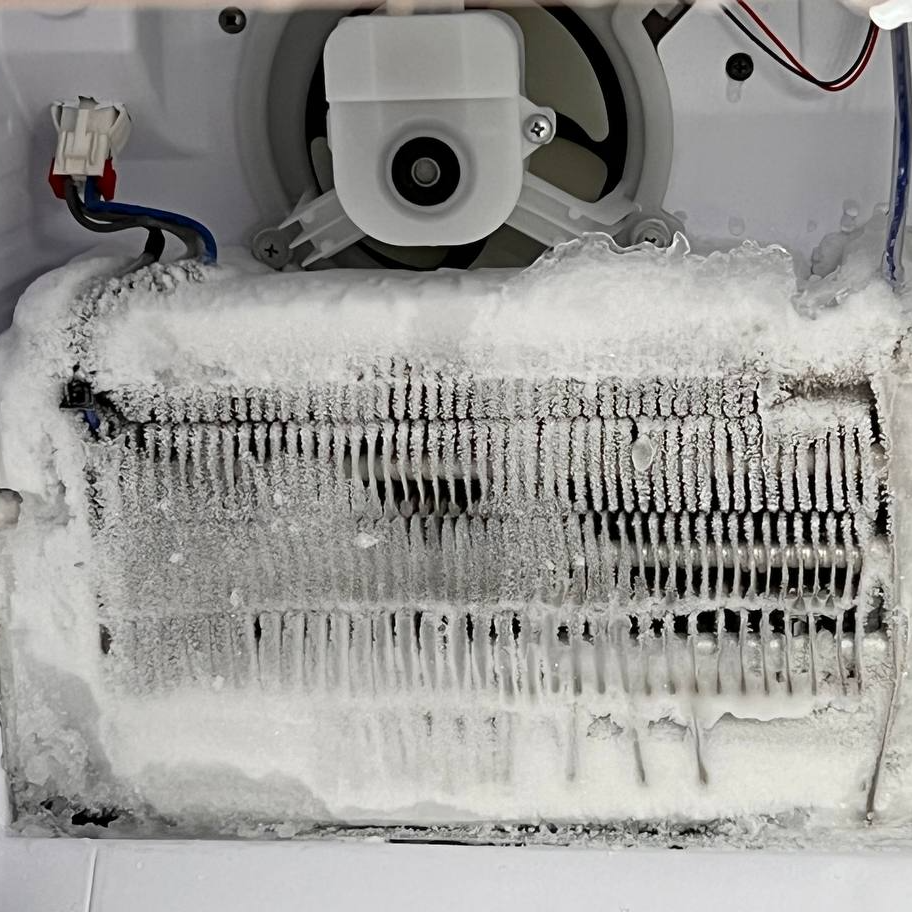
After safely accessing the evaporator compartment, we found the evaporator almost completely covered with a thick layer of ice. The ice had formed across the coil and was blocking normal airflow.
The refrigerator was continuing to run because it could not distribute cold air effectively or reach the expected temperature. The compressor was working, but the frozen evaporator prevented the system from cooling the compartments properly.
We checked the defrost heater, defrost sensor, wiring, and control operation to determine why the ice had accumulated. Testing showed that the defrost system was not removing frost from the evaporator during the normal defrost cycle.
After correcting the defrost-system problem, the ice was removed safely, and the refrigerator was tested through a complete cooling cycle. Airflow returned to normal, temperatures stabilized, and the compressor began cycling instead of running continuously.
This case shows why a refrigerator that runs constantly may not have a compressor problem. A frozen evaporator can make the cooling system work continuously while the refrigerator section becomes too warm.
It also explains why simply melting the ice is not a complete repair. If the failed defrost component is not identified and corrected, the evaporator will freeze over again.
Safe Checks Before Scheduling Refrigerator Repair
There are several things you can check without taking the refrigerator apart.
Check the doors
Make sure both doors close completely. Look for containers, drawers, or food packages interfering with the seal.
Inspect the gasket for visible gaps, tears, hardened areas, or debris.
Check the temperature
Use an appliance thermometer instead of judging temperature by touching food or shelves.
If the refrigerator runs continuously while the fresh-food compartment is becoming too warm, professional diagnosis may be needed.
Check the air vents
Do not pack food tightly against interior vents.
Blocked airflow can create warm areas and cause the refrigerator to keep calling for cooling.
Think about what changed
Did the constant running begin after a power outage, large grocery load, temperature adjustment, or unusually frequent door openings?
Temporary longer run times can have a reasonable explanation. A problem that continues for days is different.
Look for unusual frost
Heavy frost or a solid sheet of ice on the freezer’s rear interior panel can indicate that the evaporator is frozen over and airflow is being restricted.
Do not chip ice away with a knife or other sharp object. Refrigerant lines and other components can be damaged.
Also, do not assume that turning the refrigerator off long enough to melt the ice has fixed the problem. The defrost system still needs to be checked if the frost returns.
What Different Symptoms May Tell You
Runs constantly but temperatures are normal:
Check temperature settings, condenser cleanliness, door sealing, and recent usage. Some modern units naturally have long operating cycles.
Runs constantly and the refrigerator is too warm:
Airflow, fan motors, evaporator frost, sensors, compressor performance, or the sealed system may require testing.
Runs constantly with heavy frost on the freezer panel:
A defrost-system failure or restricted airflow through a frozen evaporator becomes more likely.
Freezer is cold but refrigerator section is warm:
Ice blocking the evaporator, a weak evaporator fan, blocked vents, or an airflow problem may be preventing cold air from reaching the fresh-food compartment.
Runs constantly and condensation appears around the doors:
Check door alignment and gasket sealing. Humid air entering the cabinet increases the cooling load.
Runs constantly and makes a new buzzing or rattling noise:
A fan motor or another moving component may be struggling.
Runs constantly after a power outage:
Monitor the actual temperature. If normal cooling does not return, the startup components, electronics, sensors, or compressor may need diagnosis.
When to Schedule Refrigerator Repair
Consider professional diagnosis if:
- The refrigerator runs nearly nonstop for several days
- Fresh-food temperatures rise above 40°F
- The freezer is no longer maintaining normal temperature
- Heavy frost keeps returning
- The evaporator area appears frozen over
- Airflow from the vents is weak
- The refrigerator develops a new buzzing, clicking, or grinding noise
- The compressor area becomes unusually hot
- Condensation appears together with constant operation
- Food is spoiling faster than usual
- Cleaning the accessible condenser area and checking the doors does not improve the problem
A proper diagnostic should determine why the refrigerator is running continuously before parts are replaced.
Refrigerator Repair in Fort Myers and Southwest Florida
Appliance Repair Fort Myers provides refrigerator diagnostics and appliance repair throughout Fort Myers, Cape Coral, Estero, Bonita Springs, Naples, Marco Island, and nearby Southwest Florida communities.
We diagnose refrigerators that run constantly, fail to cool properly, develop excessive frost, leak water, make unusual noises, stop producing ice, or show temperature and control problems.
Depending on the symptoms, diagnosis may include the condenser and evaporator fans, door sealing, temperature sensors, defrost components, airflow, compressor startup, controls, and sealed-system performance.
When scheduling refrigerator repair in Fort Myers, let the technician know how long the refrigerator has been running continuously, the actual refrigerator and freezer temperatures, whether you see frost or condensation, and whether any new noises have appeared.
Those details can help narrow down the problem.
A Refrigerator That Never Stops Is Trying to Tell You Something
Long run times do not automatically mean a refrigerator is failing. Florida heat, frequent door openings, and normal cooling demand can all keep the system operating longer.
But continuous operation combined with rising temperatures, weak airflow, heavy frost, condensation, or unusual noises should not be ignored.
The refrigerator may still be keeping food cold today while a fan, sensor, defrost component, door seal, or cooling-system problem is forcing it to work harder than necessary.
If your refrigerator runs constantly and never seems to shut off, schedule a diagnostic with Appliance Repair Fort Myers. We can identify what is keeping the cooling system running and determine whether cleaning, adjustment, component repair, or replacement is actually needed.