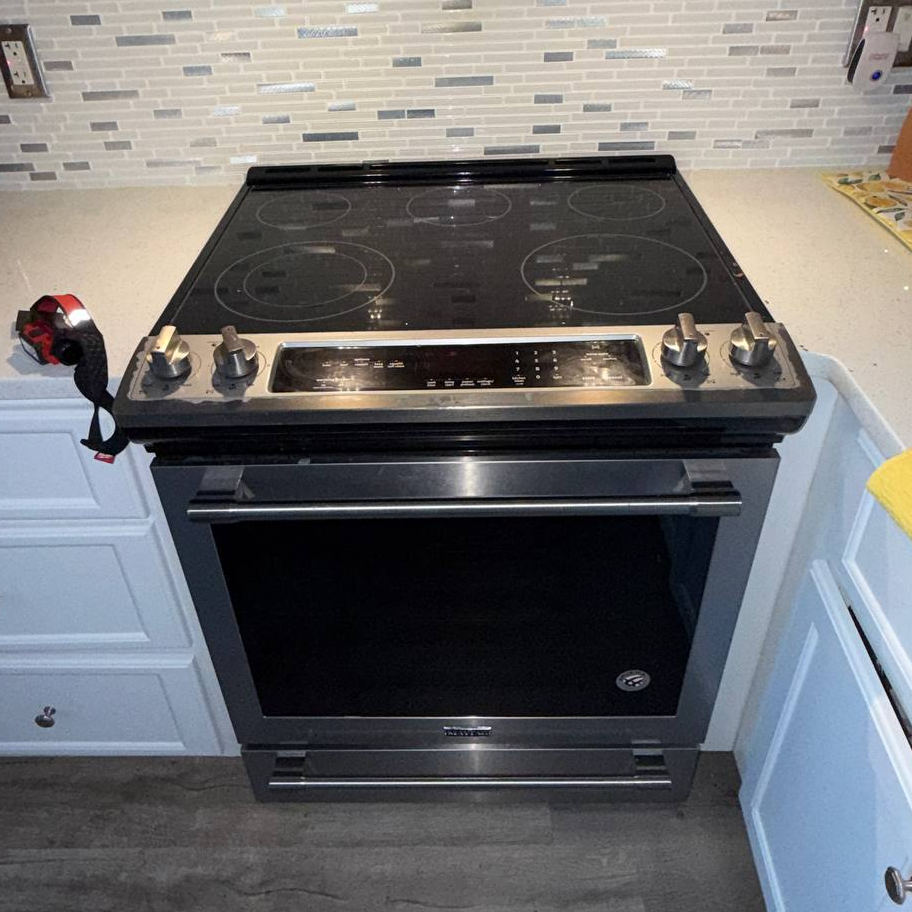
You turn an electric range burner from High to Medium, but nothing changes. The element stays bright red. Turn it down to Low, and the pan still keeps getting hotter.
That is not normal burner cycling.
An electric surface element should respond to changes at the control knob. Depending on the setting, it normally cycles power on and off to regulate heat. If the burner continues operating at maximum output regardless of the knob position, there may be a problem in the burner control circuit.
One of the most common causes is a failed infinite switch, but the switch is not the only component that can create this symptom. The surface element, wiring, connections, or electronic controls may also need testing.
More importantly, a burner stuck on high should not be treated as something you can simply “cook around.” Excessive uncontrolled heat can damage cookware, burn food quickly, and create an unnecessary safety risk.
Here is what the symptom usually means, what you can safely check, and when to schedule electric range repair in Fort Myers.
How an Electric Range Burner Controls Heat
Many electric ranges use what is called an infinite switch behind each surface-burner knob.
Despite the name, the switch does not provide an infinite number of precise temperatures. Instead, it regulates how long electrical power is supplied to the heating element during each cycle.
At a high setting, the element receives power for longer periods.
At a low setting, the switch should interrupt power more frequently so the burner can cool between heating cycles.
That is why an electric burner may glow red, dim, and then heat again during normal operation.
The important point is that changing the knob should change the burner’s heating behavior.
If the element behaves essentially the same on Low, Medium, and High, the control system is no longer regulating heat correctly.
The Most Common Cause: A Failed Infinite Switch
A failed infinite switch is one of the first things a technician may test when a burner stays on high.
Inside the switch are electrical contacts responsible for cycling power to the element.
Over years of heating, cooling, and electrical load, those contacts can wear, arc, or stick together.
If the contacts remain closed when they should open, the burner may continue receiving full power even after you turn the setting down.
You may notice:
- Burner stays bright red on Low
- Temperature barely changes when the knob is adjusted
- Food burns much faster than usual
- The burner works normally when switched off but jumps immediately to full heat when turned on
- One burner behaves differently from the other elements
These symptoms make the switch suspicious, but testing is still important before replacing it.
Could the Surface Element Cause the Same Problem?
Depending on the design of the range, a damaged surface element can sometimes contribute to abnormal heating behavior.
Traditional coil elements plug into a receptacle, while smooth-top ranges typically use radiant elements underneath the glass.
A damaged element may have internal electrical problems, overheated terminals, or other faults.
However, if the burner clearly turns on and off with the knob but simply refuses to regulate between heat levels, the control switch or control circuit is often more likely than the element itself.
A technician can separate those possibilities by checking the element, switch, wiring, and voltage rather than replacing whichever part seems most obvious.
Wiring and Connections Matter Too
Electric range burners operate on high voltage.
Loose, overheated, or damaged connections can create serious problems at the element, switch, terminal block, or wiring harness.
Signs of an electrical connection problem may include:
- Burnt smell
- Discolored wiring
- Melted connector
- Crackling or arcing
- Burner cutting in and out unpredictably
- Breaker tripping
- Visible heat damage around the control
If you notice any of these signs, stop using the range and do not remove panels to investigate unless you are qualified to work on high-voltage appliances.
Turning a knob to Off does not make every internal connection safe to touch.
What About Ranges With Electronic Controls?
Not every modern electric range controls surface elements with a traditional mechanical infinite switch.
Some models use electronic surface-control boards, relays, touch controls, or other components to regulate burner output.
If an electronically controlled burner stays on high, diagnosis may involve:
- Surface-element control board
- Relay
- User-interface control
- Temperature limiter
- Wiring
- Element assembly
That is why the symptom should guide the diagnosis rather than automatically determining the replacement part.
A Fort Myers Range Repair Case: Burner Stayed on High at Every Setting
A homeowner in Fort Myers contacted us because one burner on their electric range had become difficult to use.
The burner still turned on and off. The problem appeared after it was turned on.
Whether the knob was set to High, Medium, or Low, the element quickly became bright red and stayed extremely hot.
The homeowner first noticed the problem while simmering a sauce. They turned the burner down, but the sauce continued boiling aggressively.
After that happened again with another pan, they stopped using the burner and scheduled a diagnostic.
Our technician first checked the surface element and its electrical connections for visible damage. The element itself tested normally.
We then tested the burner control.
The infinite switch was no longer cycling power correctly. Its internal contacts were staying closed, allowing essentially full power to continue reaching the element even at lower settings.
That explained why the knob position appeared to make almost no difference.
We replaced the failed switch, reassembled the control panel, and tested the burner at several settings.
On High, the element heated normally.
At Medium and Low, the element began cycling instead of remaining continuously energized.
We also checked the other burners before completing the service.
The range did not need a new cooktop or a full replacement. The problem was isolated to the control responsible for that burner.
Why You Should Not Keep Using a Burner Stuck on High
It can be tempting to compensate by moving the pan on and off the burner manually.
That is not a good long-term workaround.
A burner that cannot regulate temperature can:
- Overheat cookware
- Burn food unexpectedly
- Damage nonstick coatings
- Cause oil to overheat
- Increase the chance of smoke or fire
- Put additional heat stress on surrounding components
If the burner does not respond normally to the control, stop using that element until the problem is diagnosed.
Safe Checks You Can Make
There are only a few useful checks a homeowner should make before scheduling service.
Compare it with another burner
Turn on another similar burner and observe how it behaves at Medium or Low.
Normal electric elements cycle. They do not necessarily remain visibly glowing at all times.
If one burner stays intensely hot while another cycles normally at the same setting, that difference is useful information for the technician.
Check the knob
Make sure the control knob is installed correctly and is actually rotating the switch shaft.
A cracked knob can sometimes turn without properly moving the control underneath it.
Remove the knob only if it simply pulls off as designed. Do not remove the control panel.
Turn the burner completely off
If the heat does not respond to adjustments, turn the affected burner to Off and stop using it.
If the burner remains energized even in the Off position, switch the range off at the circuit breaker and arrange professional service.
That symptom deserves immediate attention.
Burner Stays on High vs. Burner Stays On When Switched Off
These two symptoms sound similar but are not identical.
Burner stays on high at every heat setting:
The element switches off when the knob reaches Off, but Low, Medium, and High all produce excessive heat. The regulating control may not be cycling correctly.
Burner remains hot or energized after the knob is switched to Off:
This is a more serious control failure. Cut power to the range at the breaker rather than continuing to use the appliance.
Remember that radiant glass-top burners stay physically hot for some time after electrical power stops. Residual heat alone does not mean the burner is still electrically energized.
The concern is an element that continues actively heating or glowing when it should be off.
Other Symptoms That Can Help With Diagnosis
Only one burner is affected:
The problem is more likely to involve that burner’s element, control switch, wiring, or individual electronic control circuit.
Multiple burners behave incorrectly:
A broader control, power, or wiring issue may need investigation.
The burner overheats and smells like burning plastic:
Stop using the range. An overheated connection, switch, or wiring component may be present.
The breaker trips when the burner is used:
Do not repeatedly reset the breaker. The element, wiring, switch, or electrical circuit may have a fault.
The knob feels loose or turns strangely:
The knob itself or the switch shaft may be damaged.
The element never cycles at any setting:
The control responsible for regulating power should be tested.
Why Proper Diagnosis Matters
An electric range is relatively straightforward compared with some appliances, but guessing can still become expensive.
Replacing the surface element will not fix a failed infinite switch.
Replacing the switch will not solve damaged wiring.
And replacing the entire range because one burner will not regulate heat may be unnecessary.
A proper range diagnostic should isolate the failed part and verify that the burner responds correctly after the repair.
Electric Range Repair in Fort Myers
Appliance Repair Fort Myers provides electric range, stove, cooktop, oven, and appliance repair throughout Fort Myers, Cape Coral, Estero, Bonita Springs, Naples, Marco Island, and nearby Southwest Florida communities.
The company’s Fort Myers service pages specifically include range, stove, cooktop, and oven repair among its residential appliance services.
For a burner-temperature problem, diagnosis may include the:
- Infinite switch
- Surface element
- Element receptacle
- Wiring and terminals
- Electronic surface control
- Control board
- Power connections
The goal is to determine why the element is receiving too much power before recommending a part.
When to Schedule Range Repair
Arrange professional diagnosis if:
- A burner remains on high at every setting
- Turning the knob down makes little or no difference
- A burner continues actively heating after being switched off
- You smell burning plastic or electrical odor
- The breaker trips during burner use
- A knob or control feels damaged
- Wiring or connectors show signs of overheating
- Heat output becomes unpredictable
If the burner continues actively heating with its control switched off, shut the range off at the breaker until it can be inspected.
A Burner Should Follow the Setting You Choose
An electric range burner should give you control over cooking temperature.
If Low behaves like High, the appliance is telling you that something in the heat-control circuit is no longer doing its job.
Sometimes the solution is a single failed infinite switch. Other times, the element, wiring, or electronic controls need attention.
Either way, uncontrolled burner heat is not a symptom worth ignoring.
If your electric range burner stays on high even after you turn it down, schedule a diagnostic with Appliance Repair Fort Myers. We can test the burner circuit, identify the actual failure, and verify that the element regulates heat normally before the repair is complete.